
The Next Generation of Computer Chips Is Made in Aachen
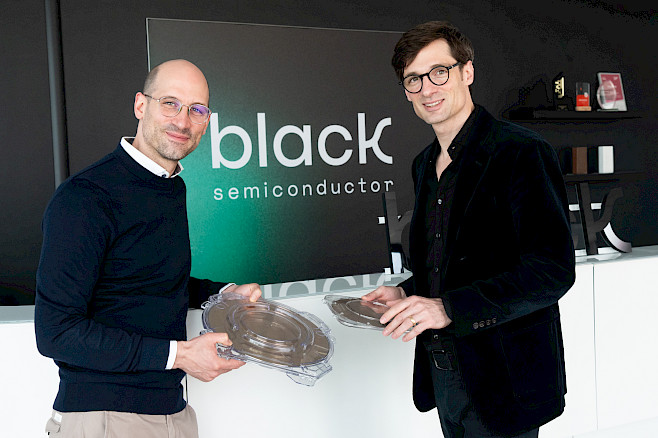
Bild: Heike Lachmann
The 2026 Aachen Engineering Award will be presented to Aachen-based founders Dr. Daniel and Sebastian Schall and their company, Black Semiconductor, on September 5.
Chips that transmit data using light instead of electricity: that is the technology Dr. Daniel Schall and his brother Sebastian Schall believe will shape the future of computing. While conventional semiconductor-based technologies are approaching their performance limits, the Schall brothers are turning to graphene, a faster and more energy-efficient material capable of converting electrical signals directly into optical ones. Once the underlying scientific and technological challenges had been addressed, the two founded Black Semiconductor in 2020 as a spinout from the AMO research institute.
As the industry came to recognize that transistors can no longer be significantly miniaturized and that gains in semiconductor efficiency are becoming increasingly difficult to achieve, interest in the young Aachen startup grew rapidly. At the same time, demand for computing power has surged, driven in part by the rapid advances in artificial intelligence. Following numerous investment rounds, a pilot line for the fabrication of graphene-based microchips on industry-standard wafers at an industrially relevant scale is now under construction in Aachen’s Rothe Erde district. The future has arrived.
It is a story that stands out even within RWTH Aachen University’s vibrant startup ecosystem, and not only because of the 15,000-square-meter FabONE production facility in Rothe Erde. The company has attracted hundreds of millions of euros in investment, grown to more than 130 employees, and drawn attention across Europe as the continent seeks to strengthen its position in the global semiconductor industry.
On Saturday, September 5, Daniel and Sebastian Schall will accept the Aachen Engineering Award on behalf of Black Semiconductor at 7pm in Aachen City Hall.
In its statement, the advisory board of the Aachen Engineering Award wrote: “By developing novel chip interconnects based on graphene, Black Semiconductor is setting new standards for energy-efficient and highly scalable data connections directly on the chip. This innovative approach addresses key performance and efficiency limitations of existing semiconductor architectures and makes a decisive contribution to the next generation of high-performance and AI systems.”
“Black Semiconductor provides a sustainable boost to Europe’s position as a semiconductor hub. By combining close collaboration with researchers and a strong industrial focus, the company embodies innovation-driven engineering excellence that is strategically vital for emerging technologies,” said RWTH Rector Professor Ulrich Rüdiger.
“Black Semiconductor signals a new industrial era for Aachen. The company is creating not only highly innovative chips, but also new jobs, international visibility, and greater technological sovereignty for Europe. We are proud that this forward-looking company has chosen Aachen,” added Dr. Michael Ziemons, Mayor of Aachen.
A Joint Award
The Aachen Engineering Award is presented jointly by RWTH and the City of Aachen, with the Association of German Engineers (VDI) serving as the award sponsor. Presented annually, it recognizes individuals whose work has made an outstanding contribution to engineering or science. This year marks the twelfth presentation of the award.
The inaugural recipient was Professor Berthold Leibinger (d. 2018), a partner at TRUMPF GmbH + Co. KG. Subsequent recipients include Professor Franz Pischinger, founder of FEV GmbH; astronaut Thomas Reiter; Professor Manfred Weck (d. 2024), longtime director of the WZL Laboratory for Machine Tools and Production Engineering at RWTH; microbiologist and CRISPR-Cas9 co-inventor Professor Emmanuelle Charpentier, now a Nobel laureate; entrepreneur Hans Peter Stihl; technology pioneer Sebastian Thrun; science journalist Dr. Mai Thi Nguyen-Kim; former BASF CTO Dr. Melanie Maas-Brunner; Airbus CTO Dr. Sabine Klauke; and, most recently, Dr. Thorsten Sieß, CTO at Abiomed and developer of the world’s smallest heart pump.
Award Partner: VDI
With around 130,000 members, the Association of German Engineers (VDI) is Germany’s largest technical and scientific association. Since 1856, VDI has played an important role in advancing innovation, promoting new technologies, and developing technical solutions aimed at improving quality of life, environmental sustainability, and economic prosperity. VDI also commissioned the award sculpture, designed by artist Mariana Castillo Deball, that is presented to each recipient.